Visibility in Action
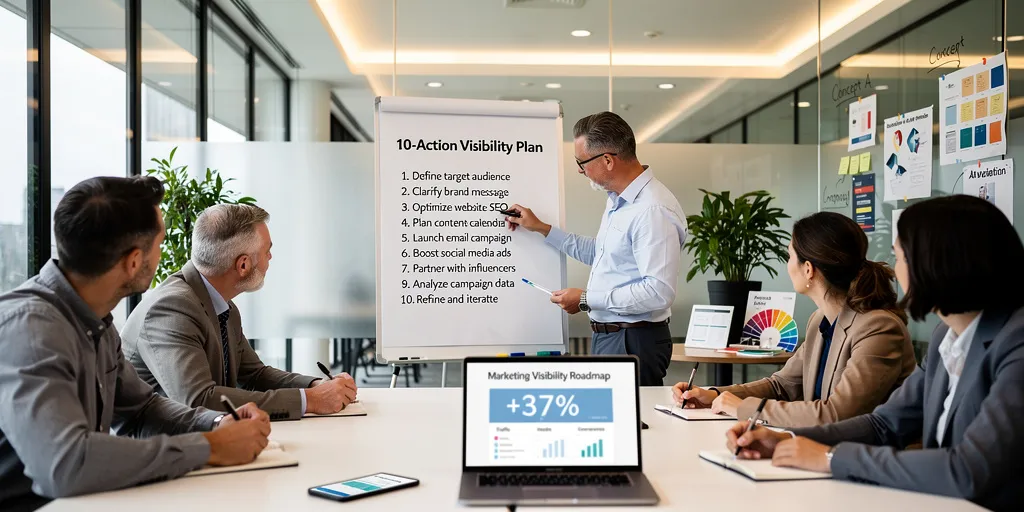
- Organic foundation: We optimize on-page SEO, create short social media content, and segment email campaigns.
- Paid promotion: We prioritize retargeting, collaborate with micro-influencers, and plan a launch event to generate a spike in attention.
- Plan and KPIs: We plan for 90 days, test, optimize through A/B testing, and track simple KPIs with weekly reviews and rapid adjustments.
When you launch a product or want to revitalize a brand, the real challenge isn’t having a good offering —it’s being seen, understood, and chosen. Between social media, online advertising, websites, content, SEO, and communications, the number of channels is growing, and your business can end up spreading itself too thin. On the contrary, the goal is to develop a clear marketing strategy, capture the target audience’sattention, create a consistent customer experience, and then increase conversions and sales over time. Why not consider a drone show?
A 10-Point Plan with Concrete Actions to Quickly Increase Your Visibility
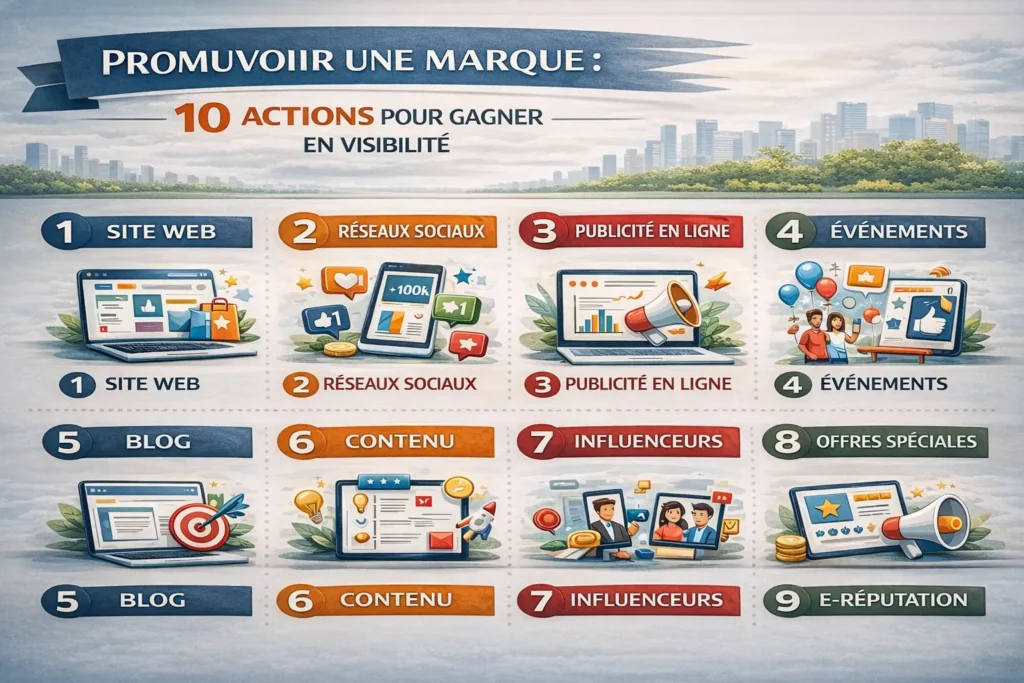
So how do you build brand awareness? An effective strategy relies on a mix of approaches: organic efforts that strengthen your brand identity and your presence in the “news feed,” followed by advertising campaigns that boost brand awareness at key moments (launches, promotions, events). The idea isn’t to be everywhere, but to choose the right channels based on your target market and your objective (traffic to your site, first purchase, average order value, customer loyalty).
The mix of paid and organic marketing efforts to prioritize for a successful launch
Start by making your website “understandable” for bothusers and Google. Proper on-page SEO, a clear product page, readable web design elements, a solid visual identity, and a unique value proposition lay the foundation. Next, you establish a content creation schedule: a short, repeatable format designed for social media and regular publication, in order to attract new customers without immediately relying on an advertising budget.
The third organic lever comes from direct marketing: a segmented email with a simple message encouragespurchases without being pushy. Next, you establish a local (or industry-specific) partnership: this “organized word-of-mouth” builds credibility and increases your visibility where your customer base already exists. Finally, you collect evidence: testimonials, photos, reviews, user-generated content (UGC), and more. Because trust in the brand is built on what others see, not on what you claim.
A mix of paid promotions, influencer marketing, and events, to be tailored to the budget and objectives
Once the foundation is in place, commercial advertising becomes an excellent way to quickly reach a wide audience. You choose a targeting strategy that aligns with your audience, test several creative options (images, videos, taglines), and track the results. Micro-influencing works well if you’re looking for a specific target audience: a credible influencer, authentic content, and a trackable link to your page.
Press relations—especially at the local level—provide “media” coverage and brand awareness that are hard to buy elsewhere, provided you have a compelling angle and newsworthy information to share. A launch event (store opening, retail event, demonstration, interactive experience ) generates a surge of attention and fuels your social media channels. Finally, retargeting turns curiosity into sales: a user who has seen your product but hasn’t purchased it receives a follow-up ad or a targeted discount, which improves your conversion rate.
| Action | Effort | Estimated cost | Expected result |
|---|---|---|---|
| On-Page SEO + Organic Search Engine Optimization | Medium | Low | Growing organic traffic |
| Recurring Social Media Content | Low | Low | Commitment and Recognition |
| Targeted Email Campaigns | Low | Low | Lead Conversion |
| Partnerships | Medium | Low | Targeted visibility |
| User-Generated Content + Testimonials | Low | Low | Credibility |
| Social Advertising | Low | Medium | Rapid Acquisition |
| Micro-influencer | Medium | Medium | Social Proof |
| Targeted PR | Medium | Low to moderate | Media Coverage |
| Launch Event | High | High | Peak Attention |
| Retargeting | Low | Medium | Increased conversion |
Trending Activities to Energize a Corporate Seminar
Today, a seminar is no longer just a series of presentations and slides. Companies are looking to create a truly shared experience—one that people will still remember months later. That’s why formats are evolving. We’re seeing the emergence of immersive workshops, collaborative escape games, virtual reality experiences, and even artistic performances tailored to convey a specific message.
But when it comes to making a lasting impression, certain types of entertainment go a step further. Light drone shows, for example, are becoming increasingly popular at corporate events. Imagine the closing ceremony: the lights go out, everyone looks up, and animated shapes appear in the sky—a logo, a tagline, or a strategic message transformed into a living tableau. The effect is immediate.
Beyond the technological feat, it’s the emotional aspect that makes all the difference. A drone show allows you to tell a story, bring a vision to life, and bring teams together around a shared moment. While a traditional performance entertains, drones create a collective memory. And it’s often that memory that lasts.
Allumee’s support for incorporating a drone show into your seminar
Allumee designs and produces custom drone light shows for your corporate events. The process begins with a site survey to assess technical feasibility, regulatory constraints, and safety requirements.
Each show is then choreographed to suit your objective: highlighting your logo, conveying a strategic message, launching a product, or creating a unifying closing moment. The performances are programmed and synchronized to create a striking aerial display.
Allumee handles the technical coordination, the necessary permits, and operational management on the day of the event. You’ll benefit from a secure, well-managed service designed to leave a lasting impression on your teams.
Frequently Asked Questions About Brand Promotion
What does it mean to promote a brand?
Promoting a brand means working on brand marketing to enhance the brand’s image and build trust. It’s about creating and maintaining a relationship between the brand and the consumer—not just selling a product. We clarify the brand’s attributes—those elements that come to mind when customers think of the brand. Visual branding, communication tone, promises and proofs, customer service—it all matters. The goal? To ensure that the mere mention of the brand inspires trust and preference. It’s a long process, sometimes frustrating, but rewarding in the long run—and it requires consistency, patience, and feedback.
How can I promote my product?
To promote a product, we combine digital strategies with on-the-ground initiatives, leverage the power of social media, publish sponsored articles, collaborate with relevant influencers, launch targeted email marketing campaigns, and place well-positioned display ads. Organizing a launch event helps generate buzz and press coverage. It’s important to consider your audience, message, and frequency, and to measure, test, and iterate. Sometimes a micro-influencer can make a bigger impact than a major campaign; sometimes a well-written email opens doors. Get your hands dirty, refine your target audience, track your KPIs, and celebrate every small victory.
What is the 7-11-4 rule in marketing?
The 7-11-4 rule—or 7-1-4 rule—states that it takes about seven hours of content delivered across eleven touchpoints spread across four locations or platforms to turn a stranger into a customer. It sounds precise, yet it’s a practical way of reminding us that frequency and diversity are key. In short, increase the number of touchpoints, vary the formats, and measure the results. The more a person is exposed to your content, the more they trust you, and the more likely they are to buy. Here’s a practical tip: develop a multi-platform action plan, and accept that this is a marathon, not a sprint. Start small, and think long-term.