How do you put on a drone light and sound show?
Putting on a drone light and sound show is a technological and artistic feat that blends creativity, precision engineering, and synchronization. These drone ballets light up the night sky, where hundreds or even thousands of drones equipped with LED lights create shapes, patterns, and animated scenes, all set to an immersive soundtrack. In this article, Allumee outlines seven key steps for successfully carrying out such a project.
The Meeting and Technical Review
This initial phase is crucial because it lays the groundwork for the entire project and ensures that the client’s expectations are fully understood and achievable within the technical and creative constraints of the proposed production. During this initial meeting, the main objective is to immerse ourselves in the client’s vision. This involves understanding the emotion or message they are seeking to convey to the audience.
This is also the time to highlight realistic constraints such as budget, site and safety conditions, and equipment limitations. An essential component of the technical study is the assessment of the site wherethe drone light show will take place; this may include evaluating the physical dimensions, the environment (including potential obstacles such as buildings or trees), typical weather conditions, and any other factors that could affect the drones’ performance or the safety of the show.
In addition, logistical aspects are also addressed, including the establishment of takeoff and landing zones, the planning of flight paths, and the implementation of safety measures to protect the public and operators.
Finally, an analysis of additional technical requirements is conducted, which may include sound equipment for music and commentary, as well as other elements that contribute to the overall experience.
The Storyboard
This step is essential for translating the client’s vision and objectives into a concrete visual and narrative plan. It is a crucial transitional phase where abstract ideas begin to take shape. At the same time, the storyboard specifies the use of lighting and special effects —including the colors and intensity of the lights on the drones, as well as any special effects on the ground or integrated into the drones themselves, such as the ignition of traditional fireworks.
Finally, the soundtrack is an integral part of the show, and its selection is closely tied to the storyboard. For each segment of the show, a music track is selected or composed to support the mood and visual movements. The music guides the rhythm of the animations and reinforces the cohesion between the show’s visual and auditory elements.
The storyboard is regularly shared with the client to ensure that the artistic direction meets their expectations.
Production
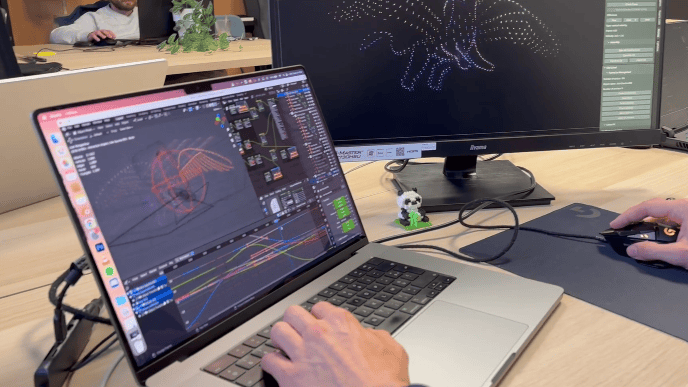
This stage involves several key processes, including the creation of the visual, audio, and technical elements necessary to deliver a memorable experience for the audience. It is during this phase that ideas come to life through the use of the latest technologies and the expertise of highly qualified teams. First, the storyboard and music must be imported into the software, which often provides a visual interface that allows users to “draw” the drones’ flight paths in 3D space.
The creative team designs the visual elements of the show. This includes selecting colors, determining the intensity of the lights on the drones, and designing the patterns and shapes that the drones will form in the sky.
However, adjustments may be necessary to refine the visual elements. This refinement phase is essential to ensure that the show achieves the desired level of excellence.
If you’d like to learn more about what goes on behind the scenes in creating a drone show, check out our Instagram story on the topic: https://www.instagram.com/reel/C3hfnt2KTat/?utm_source=ig_web_copy_link&igsh=MzRlODBiNWFlZA==
Audio-Visual Synchronization
Once the production elements have been finalized, the focus shifts to precisely synchronizing each drone movement, lighting effect, and special effect with the show’s soundtrack.
Once the musical structure is established, the drones’ programming can be adjusted to align with the musical elements. Flight control software is used to precisely synchronize the drones’ flight paths, formations, and color changes with the music. This step requires a high degree of precision to ensure that the drones’ movements correspond to specific moments in the audio track.
At the same time, the special effects and lighting are also programmed to activate at specific moments. Whether it’s to highlight a musical crescendo with a burst of fireworks or to change the colors of the drones in sync with a shift in the music’s key, every detail is meticulously planned to enhance the audiovisual impact of the aerial performance.
Permissions
It is essential to navigate the regulatory framework by obtaining various permits that vary by jurisdiction and are generally intended to ensure public safety and environmental protection. Thus, a flight permit ensures that drone operators are qualified and that the aircraft used are capable of flying safely.
In addition to flight permits, specific safety authorizations may be required to ensure that the show poses no risk to the public, surrounding structures, or airspace. This may include risk assessments, emergency planning, and coordination with local emergency services to ensure that response protocols are in place in the event of an incident.
Depending on the venue and the nature of the performance, other approvals may be required, such as permission to use public space, to install temporary structures like stages or screens, and to use music or other intellectual property.
The Tests
This phase allows us to verify the reliability of every aspect of the show, from drone performance to audio-visual synchronization and safety. The tests are conducted under conditions that are as close as possible to those of the final show in order to identify and correct any potential issues.
First and foremost, every drone undergoes a thorough technical inspection to ensure it is in proper working order. This includes checking the battery, motors, and sensors.
Dress rehearsals with the full soundtrack and all visual effects allow us to see the show in its entirety and make final adjustments.
The Production
This is the culmination of the entire creative process, where the artistic vision meets its audience. This phase involves not only the technical execution of the show but also a commitment to safety, quality, and environmental responsibility, ensuring an experience that is both emotionally engaging and environmentally friendly.
The essence of a drone show is to move the audience. Through a masterful combination of music, light, and movement, the show aims to create unforgettable moments that inspire wonder, joy, and sometimes even reflection.
Want to learn more?